Ravinder Tulsiani
Your Leadership Edge
Book & Framework
Your Leadership Edge
A leadership capability lens for decision quality, influence, and execution.
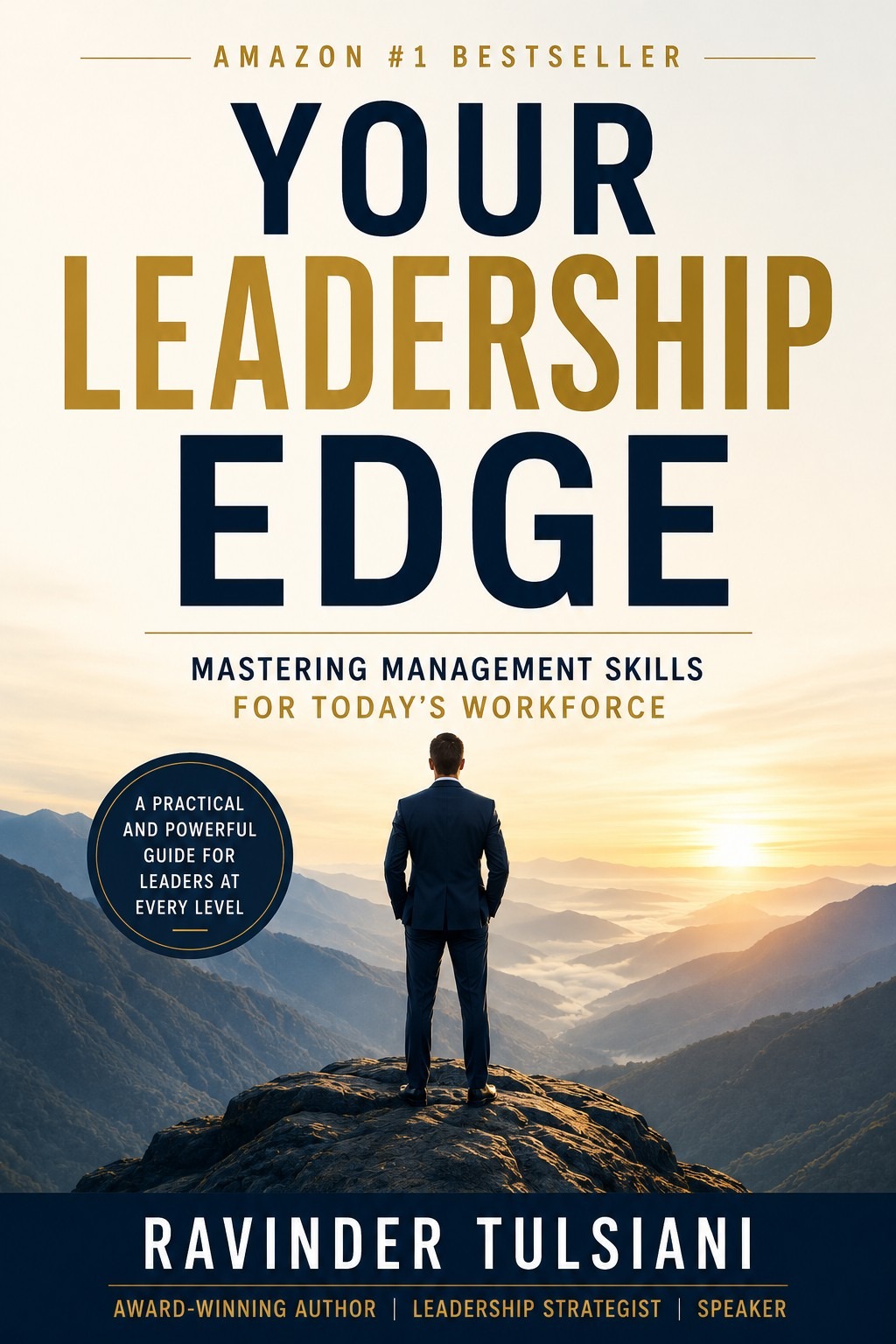
Executive intro
Your Leadership Edge is about helping leaders understand the capabilities that make them more effective in complex work: clarity, judgment, influence, accountability, and performance discipline.
Your Leadership Edge helps leaders translate intent into the behaviors and decisions that shape performance.
Core idea
Leadership edge comes from better decisions and stronger conditions for others to perform.
The framework is designed for leaders who need sharper questions before they commit resources. It helps translate broad ambition into visible decisions, practical operating choices, and evidence that can be discussed with executives without hiding behind learning jargon.
Why it matters now
Leaders are being asked to guide teams through AI, change, uncertainty, risk, and higher expectations with less room for vague leadership language.
AI, workforce disruption, cost pressure, and changing employee expectations have made weak capability systems harder to defend. When priorities are unclear, organizations spend energy producing activity. When the capability logic is clear, leaders can decide what deserves investment, what should stop, and what evidence would make progress credible.
How leaders apply it
Use the framework to clarify decision habits, stakeholder influence, team conditions, and the behaviors leaders must model under pressure.
In practice, leaders use the framework as a working conversation. It can shape discovery, executive alignment, program design, measurement planning, manager enablement, and post-launch improvement. The value is not in a canvas or model by itself. The value is in helping people make better decisions sooner.
Common mistake it prevents
It prevents treating leadership development as inspiration without operating behavior.
The mistake matters because learning and transformation teams are often rewarded for visible production: launching programs, publishing content, filling calendars, and reporting participation. Those activities can be useful, but they are not proof that the organization has strengthened the capability needed for execution. The framework slows the work down just enough to ask better questions before speed creates waste.
Used well, the framework also improves the relationship between learning leaders and business leaders. It gives both sides a shared language for outcomes, behavior, adoption, risk, evidence, and ownership. That shared language is what prevents capability work from becoming either abstract strategy or disconnected training activity.
Executive application
For senior leaders, the application is less about adopting a model and more about improving the quality of decisions. The framework helps expose assumptions before they become sunk cost, connect stakeholders around a common definition of success, and keep the work anchored in performance rather than internal learning production. It is especially useful when the organization is under pressure to modernize quickly, adopt AI responsibly, reduce cost, strengthen leadership, or scale capability across different groups.
The strongest use case is an executive conversation where people are aligned on urgency but not yet aligned on the work. The framework gives that conversation structure. It helps leaders identify what must be decided now, what can be tested, what evidence will be trusted, and who owns the conditions for performance. That is what turns a concept into operating discipline.
It also creates a cleaner handoff from strategy to execution. Teams leave with a stronger brief, clearer accountabilities, and a better way to review progress without reverting to activity metrics alone, in language executives can quickly use. That clarity is what makes the framework practical for boards, HR leadership teams, operating leaders, transformation sponsors, senior teams, finance partners, and senior decision makers.
- Clarify the business outcome before committing to a learning format.
- Name the capability, behavior, and operating conditions that matter most.
- Identify where leadership, systems, workflow, data, or incentives may block performance.
- Define evidence that can be reviewed by business leaders, not only learning teams.
- Use the framework to make tradeoffs visible and accountable.